
A four-part limited television series, Burke and Hare is a dark, suspenseful dramatization of the infamous 19th-century serial killings that exposes the hidden economy beneath Edinburgh’s respectable surface. Set in 1828, the story follows reporter Archibald Johnson as he investigates a rise in grave robbing across the city, a pursuit that draws him deep into the dangerous underworld of Scotland’s capital. His investigation leads to William Burke and William Hare, two destitute labourers who exploit poverty and invisibility to murder society’s most vulnerable, selling their victims’ bodies to the ambitious anatomist Dr. Robert Knox. As Johnson uncovers a network of corruption linking crime, science, and privilege, the series reveals a world driven by power and greed, where the rich prosper at the expense of the poor and institutional complicity allows atrocity to thrive in plain sight.

Transported to Australia in the mid-19th century, Greatrex follows John Henry Greatrex, a young convict who arrives determined never to be powerless again. Gifted with charm, intelligence, and a complete disregard for truth, he reinvents himself through lies, petty crimes, and calculated betrayals, rising from destitution to respectability in colonial society as an actor, businessman, and preacher. As his appetite for wealth and status grows, Greatrex becomes entangled in an ambitious international banknote forgery scheme alongside the skilled but desperate Grimshaw brothers, expanding his crimes across borders and continents. His carefully constructed double life draws the attention of Superintendent Alexander McCall, a relentless investigator who begins to peel back the layers of deception. As pursuit tightens and alliances fracture, Greatrex’s world collapses under the weight of his own ambition, revealing that his greatest con is not the crimes he commits, but the belief that he can outrun consequence itself.

When a seismic research vessel uncovers a vast oil reserve beneath the disputed Pacific island of Sanguma Motu, the discovery triggers a volatile struggle between global superpowers, corporate interests, and covert forces operating beyond public scrutiny. As the United States, China, and Russia manoeuvre military assets and political leverage, charismatic Iblis-X CEO Gerrat Tensh exploits the crisis to advance a far darker agenda, manipulating world leaders whose polished façades conceal corruption, vice, and moral decay. Amid this escalating geopolitical brinkmanship, Hamidi Abdullahi—a faith-driven figure with supernatural insight—moves unseen across continents, confronting assassins, agents, and power brokers while warning that humanity’s greed has awakened an ancient malevolent force he calls the Dark Angel. As political ambition, corporate greed, and spiritual corruption converge toward global catastrophe, Triumvirate unfolds as a sweeping international thriller that questions whether faith, conscience, and sacrifice can still alter the course of a world racing toward self-destruction.

Triumvirate 2 follows Ethen Prest, the newly elected President of the United States, whose promises of prosperity, security and national renewal conceal a far darker truth: he is a demon intent on dismantling democracy and remaking the world in his own image. Armed with the ancient Black Seal of the Seven Winds and supported by the deadly Marilyn and Jane, Ethen begins tightening his grip on America before turning his attention to Europe, using fear, manipulation and supernatural power to bend governments and institutions to his will. Standing against him are prophet Hamidi Abdullahi and fugitive ex-FBI agent Cathleen Henshaw, whose uneasy partnership develops into a determined resistance as the threat becomes increasingly personal. Journalist George Kelso is drawn into their fight, while the mysterious child Meti reveals abilities that may be connected to forces far older than Ethen’s presidency. With allies murdered, nations falling under Ethen’s influence and the shadow of Cerberus looming behind events, the struggle escalates into a race to prevent one man’s vision of order from becoming a global catastrophe.
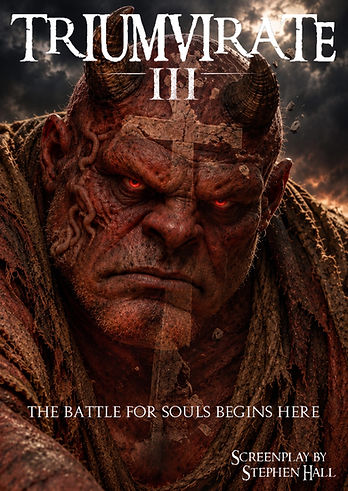
When the ancient demon Cerberus escapes through an abandoned mine in Death Valley, he sends a human emissary into the world to turn faith itself into a weapon. Taking the charismatic form of Hart Chepere, a miracle worker and spiritual celebrity, the demon builds a global following while secretly engineering attacks on sacred sites across Jerusalem, Rome and beyond. As fear spreads and nations begin blaming one another, Hart’s message of hope hardens into grievance, division and religious conflict, pushing the world toward a catastrophic Holy War.
Standing against him are Hamidi Abdullahi, fugitive ex-FBI agent Cathleen Henshaw and Hamidi’s daughter Meti, whose growing supernatural abilities reveal that she shares her father’s mysterious Re-inc existence. Their pursuit takes them across Europe, America and the Middle East as demonic agents infiltrate intelligence services, personal loss fractures Hamidi’s family and Cerberus’s plan accelerates toward open war. As Hart’s public influence and Cerberus’s supernatural power converge, Triumvirate 3 becomes a global thriller about faith, manipulation and sacrifice—and whether belief can remain a source of hope when fear is deliberately used to turn humanity against itself.

Love Is a Stranger is a contemporary Gothic fable about ambition, mortality, and the hidden cost of being seen. Johnny Lyle, a drifting twenty-six-year-old illustrator, scrapes by selling toiletries door-to-door while dreaming of an art career that never quite begins. When he meets Aveline De Clare, a wealthy seventy-two-year-old widow, he is drawn into her world of refinement, grief, and unsettling generosity. Aveline offers Johnny a supernatural pact: her blood will grant him vitality, creative brilliance, and access to a life he has only imagined—but at a terrible price. As Johnny’s career explodes and Aveline rejuvenates, revealing herself to be centuries old, his personal life fractures; his childhood friend Diane grows suspicious, and his parents’ grief and his mother’s dementia anchor him to a finite life he has chosen to escape. While Aveline flourishes, Johnny begins to age and fade, realising too late that the legacy he leaves behind will never truly be his. In the end, violence and loss claim both Johnny and Diane, while Aveline survives to carry his art—and his memory—into her endless future, leaving behind a haunting meditation on success, desire, and the seduction of being chosen.

Set in 1985, Rising Star follows veteran detective Logan Ford, a worn-down cop whose instincts and hard-earned reputation have carried him through decades on the job, and Malik Edwards, a sharp, guarded rookie whose intelligence and restraint mask deep personal risk. When a young sex worker is found dead from an apparent overdose in a hotel room, the case quickly widens to expose political corruption, organised crime, and a dangerous new drug known as Rising Star. As bodies begin to surface—posed with ritualistic precision like grotesque marionettes—the investigation draws the detectives into a shadow network linking crooked politicians, mob enforcers, and a long-dormant serial killer believed to have once terrorised Philadelphia. While Malik follows evidence that points toward a respected social worker with a hidden past, Logan becomes convinced the killer is his quiet neighbour, a meticulous puppeteer, and his certainty hardens just as the truth begins to fracture. When the case finally closes, justice proves incomplete: the wrong man is cleared, the real killer remains free, and Logan is publicly rewarded even as his faith in his own instincts quietly collapses, leaving both men irrevocably changed by a case that exposes the cost of mistaking certainty for truth.

When a SWAT raid on a quiet suburban home erupts into a devastating explosion, veteran detective Logan Ford is thrust back into chaos as evidence reveals the return of Peter Denton, a serial killer long believed buried after a previous case. No longer operating in isolation, Denton is building something far more dangerous—a revolutionary movement fueled by ideology, vengeance, and escalating acts of terror that plunge the city into political unrest. As bombings spread and key figures are eliminated with brutal precision, Logan’s pursuit becomes deeply personal, pushing him toward the edge of vigilantism. Meanwhile, Malik Edwards has stepped out from his mentor’s shadow, forging his own moral and political stance as loyalties fracture and his path begins to diverge from Logan’s. As a new generation of radicals rises under the cold, calculating leadership of Tilly, Rising Star II becomes a tense, emotionally charged sequel about legacy, consequence, and the widening gulf between personal justice and systemic failure—where stopping the violence may demand becoming part of it.
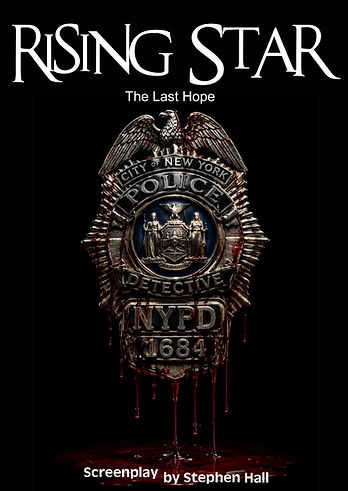
Set in 1987, Rising Star III is a gritty New York crime thriller that brings detectives Logan Ford and Malik Edwards into conflict with corruption inside their own police force. When the massacre of a mob crew exposes links between organised crime, the Rising Star drug trade and a group of rogue officers, Logan goes undercover while Malik becomes increasingly isolated and vulnerable. As their partnership is deliberately fractured, Logan’s trauma threatens his family, Malik’s private life is weaponised against him, and a surviving disciple of the Puppet Master returns with a deeply personal vendetta. The investigation forces both men to confront the true cost of loyalty, justice and wearing the badge when the institution behind it can no longer be trusted.

Framed by testimony at the 2020 Scottish Child Abuse Inquiry, The Deceit and Desire unfolds as Patricia Dishon reveals the buried history of child transportation schemes that scarred generations. The story moves back to Edinburgh in 1882, where Arthur Delaney, an impoverished Irish immigrant descendent living on the Royal Mile, is shattered by the death of his wife Mary and their newborn during childbirth. Overwhelmed by grief and struggling to care for his three young children, Arthur is persuaded by Miss Guthrie of the Edinburgh and Leith Children’s Aid and Refuge Charity to place them temporarily into care, reassured they can be returned at any time. Unbeknownst to him, the charity’s anti-Catholic director Emma Stirling is orchestrating a secret agreement with the Canadian government to export vulnerable children as labourers, and Arthur’s children are shipped to Nova Scotia without his consent. Broken by guilt and alcoholism, Arthur eventually finds redemption through the compassion of Cecilia and, with the help of Father Hannan and a determined legal fight, exposes the charity’s crimes. Armed with a court victory, he embarks on a perilous transatlantic journey to reclaim his children, confronting a brutal system of institutional power, religious bigotry, and exploitation in a harrowing historical reckoning where justice favours the wealthy and innocence is the cost of progress.

Haunted by a childhood car crash that killed his parents, Jack Corral survives adulthood by maintaining a fragile equilibrium of therapy, medication, and a group of imagined flatmates who represent fragments of his fractured psyche. When he impulsively abandons his medication and meets Amy, a warm, intuitive artist, Jack experiences an emotional awakening that offers the possibility of genuine connection — but also destabilises the inner world that has protected him. As Jack is unexpectedly labelled a public hero after saving a child, a journalist begins probing his life, while darker internal forces surface, led by Gerrat Tensh, a powerful and destructive persona determined to isolate Jack from reality. As his flatmates grow erratic, cryptic warnings appear, and a new internal “agent,” KP, emerges to defend Amy, Jack uncovers a hidden darkroom filled with surveillance images documenting his entire life, revealing that his inner selves have been watching — and controlling — him all along. Forced into a final confrontation with Tensh, Jack must choose between retreating into isolation or embracing intimacy, emerging into an uneasy quiet where the threat may not be gone, but for the first time he is willing to face the future with Amy at his side.

Three sixty-year-old friends—Danny, Ricky, and Peter—set out on a guided underground tour beneath Edinburgh’s Royal Mile, expecting little more than history and mild nostalgia, but after drinking a mysterious whisky and choosing the wrong tunnel, they stumble back onto the streets of 1984—twenty-one again in spirit, yet trapped in their ageing bodies. Thrown into the chaos of the Edinburgh Festival, they reconnect with their younger selves, their student flat, punk clubs, first loves, and even a shockingly talkative dog, reliving the recklessness and freedom they thought were long behind them. What begins as euphoric nostalgia spirals into danger when their dog accidentally steals a stuffed panda concealing stolen jewels, drawing the trio into a frantic chase involving a chaotic biker gang led by Baba Fatt and a series of surreal misadventures across the city. As time runs out and their chance to return home approaches, the friends are forced to confront what truly matters—clinging to youth or embracing the lives they’ve become—making Going Underground a heartfelt, anarchic time-travel comedy about friendship, aging, missed chances, and the perilous joy of revisiting the past.